
Stations
Discover Brain Fair 2025's activities
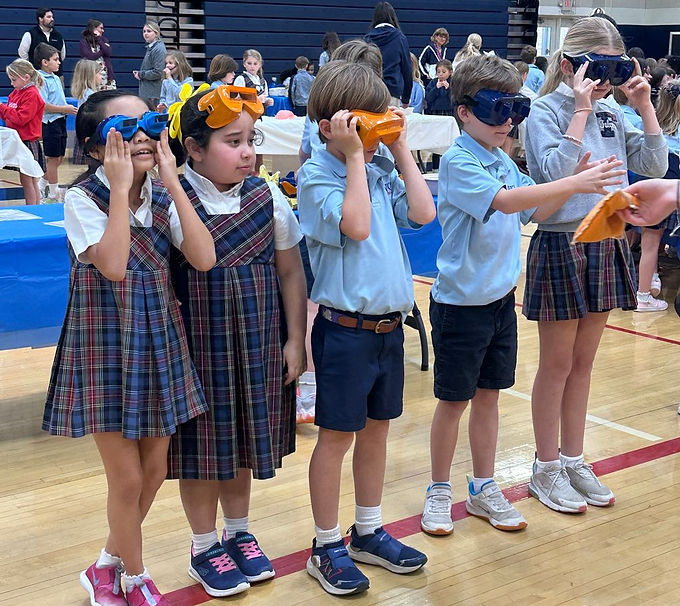
Super Shades - Distortion Glasses
Students toss bean bags into hula hoop circles while wearing vision-distorting glasses to better understand the occipital lobe's role in vision and sensation vs. perception.

The Stroop Color and Word Test
Students peruse a list of colors that are written in a different color than their own (i.e. red written in blue) and try to say the name of the color in which the word is written. This is the Stroop test, and it evaluates kids’ “ability to inhibit cognitive interference that occurs when the processing of a specific stimulus feature impedes the simultaneous processing of a second stimulus attribute” (Frontiers).
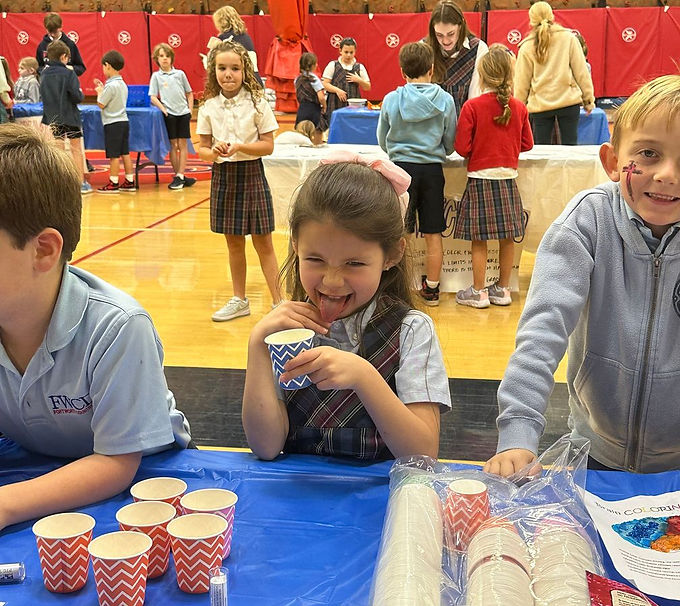
PTC Strip and Miracle Berry Tasting
Participants try a PTC strip (taster vs non-taster), then eat a miracle berry and drink lemon juice, which will taste sweet after having the berry. This teaches kids about the gustatory complex and how it influences our sense of taste.

"You're a Star" Mirror Drawing
Participants draw a star with their hands below a box, where they can only see their drawing through a mirror. This activity elucidates our reliance on our brains to automatically complete tasks like walking and breathing, but how our brains cannot do that when something is switched, like drawing backwards through a mirror.

Brain Safety
Participants toss ball at regular brain jello mold and see how it dents the jello (brain); participants then toss ball at jello with bowl (helmet) on top and see how the jello is protected.

Brain-Food Blender
The station leader puts piece of cod (represents brain) in a blender and mixes it with foods that are good and bad for the brain. The foods that are good for the brain will blend smoothly; those that aren't will not.
.jpeg)
"Build-a-Brain" diagram labeling
Participants color and label (using markers, glitter glue, paint, etc.) a diagram of the brain and of a neuron, which helps them visually understand neuroanatomy and the role/importance of each part of the brain.

"Who's Who?" Animal Brain Matching
Students match an image of a brain to its animal, which allows them to compare animals’ brains to their cognitive abilities (Example: explain why the dolphin’s brain is so much larger and more complex than the human brain).

"Pin the Part on the Brain"
Pin the tail on the donkey, just with neuroanatomy!

Scrambled Words Reading
Piicratpntas raed paarrgph wrhee all wdros olny hvae frsit and lsat lteters in the rgiht pacle. Tihs is a penhmonoen taht dstmtnraoes the Wcikere Aera's aiitlby to pseocrs wtriten lgnuagae vrey qcuilky.

Taste the Rainbow
Participants watch as a ring of skittles dissolves on a paper plate, acting as a fun visual representation of diffusion and osmosis in the brain.

"Cup Castle" Cup-Stacking
Participants make a pyramid-shaped stack of cups, then take it down as fast as they can. This teaches kids about the motor cortex and the function of the neurons in a fun, competitive way.

Concentration
Station leader shows the participants and array of cards and lets the players see the cards for 5-10 seconds before flipping them over. The players then try to match similar cards based on their own memory. This teaches kids about the hippocampus and how it affects people’s memory.
.jpeg)
"Close-Up" Microscope Demonstration
Students observe brain tissue through a microscope. This shows the inner workings of the brain, teaches about brain anatomy, and shows which parts of the brain serves which function and how the purpose is reflected by the brain’s appearance.

"Now You See It..." Optical Illusions
Students peruse images of various optical illusions, such as the Hermann Grid, Kanizsa Triangle, and Müller Lyer illusions, which teaches them about the ways in which the brain connects with the eyes (retina mainly) and why our brains process certain images/illusions the way that they do.

"Say What??" Speech Jammer
Participants are given a pair of headphones and a printed passage to read. The station leader then uses a speech jammer app on their phone to delay auditory feedback, meaning that the participant will hear their words a few seconds after they are said. This simply explains the importance of auditory feedback and hearing one’s own voice when speaking, specifically in the temporal lobe's auditory cortex.
_edited_edited.png)
"Mind Muscle Machine" Robot
This was my favorite station from the Northwestern fair. Students control lego robots by contracting their muscles by using the LEGO Mindstorm robot machine.

You Choose!
What activities would you like to see at Brain Fair 2026?